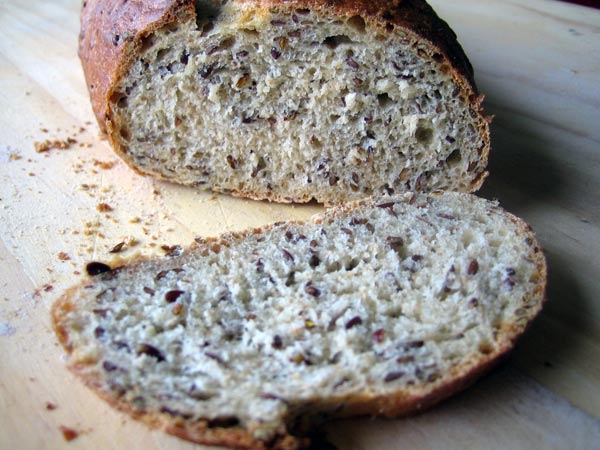
I finally got my copy of Dan Lepard's The Handmade Loaf, a book that the Brits on this site have been recommending to me for a while. Occasionally imported copies will show up on Amazon
Of the recipes I've baked so far, the Linseed and Wheat Bread has been my favorite. The first loaf I baked we ate in under an hour. I was forced to bake it again the next day. The horror.
The recipe I'm posting below is based on his Linseed and Wheat Bread. I modified it some to match the ingredients I had on hand and my personal taste.
Flax Seed Wheat Bread
makes 1 one pound loaf200g bread flour
50g whole wheat flour
1 teaspoon salt
100g flax seeds
2 teaspoons malt powder
150 grams water
1 teaspoon instant yeast
Combine the flours, salt, seeds, malt, and yeast in a bowl. Stir in the water and mix until thoroughly combined. This dough is not a terribly moist one: it should be slightly tacky but not sticky. When shaped into a ball it should easily hold its shape.
The seed and bran from the whole wheat prevent a high level of gluten development in this dough, so extensive kneading is not necessary.
Once all of the ingredients are thoroughly combined, place the ball of dough in a greased bowl. Cover with plastic wrap and leave to rise for an hour to an hour and a half.
Shape the dough into 1 large or two small loaves, cover the loaves with plastic, and give them another hour to rise. In the meantime, preheat the oven and baking stone to 425 degrees.
Brush the top of the loaves with water, score the loaves, and place them in the oven. Bake them at 425 for 20 minutes, rotate them 180 degrees, then bake them another 20 to 25 minutes. When done, they will be nicely browned on the outside, make a hollow sound when tapped upon, and register approximately 205 degrees in the center when measured with an instant read thermometer.
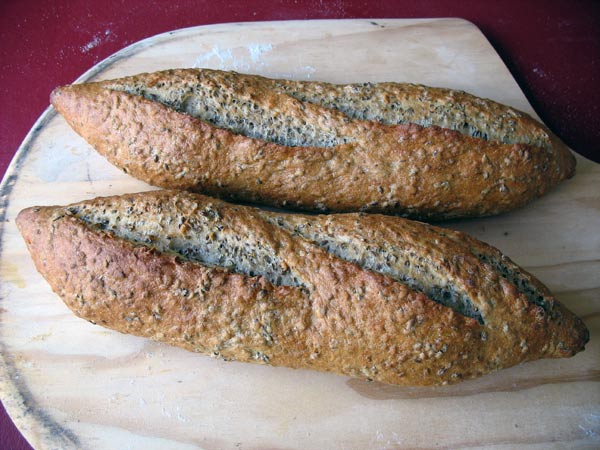
These loaves remind me of yams.
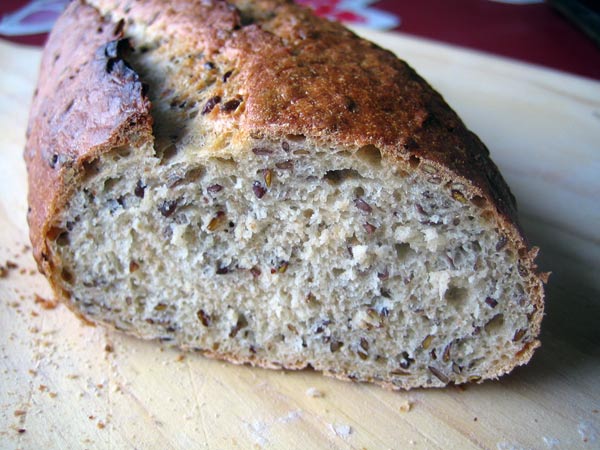
Related Recipe: Five Seed French Bread
Flax Seed Wheat Bread


- Log in or register to post comments
- Printer-friendly version
Comments
I thought this was initally a nice starter dough. Good job. I am suprised that a straight dough can be this nice.
Ryan
I didn't realize that these were the same things! Ha! I learn something new every day. To think that we can bake with it, paint with it, walk on it, and wear it (linen)!!
Is the malt powder essential? I live in Luxembourg and that isn't available here. If it is, what could I substitute for it?
No, the malt powder isn't essential. You could substitute in any sweetener... brown sugar, white sugar, molasses, honey, whatever you have in the house.
Could I use plain Ovaltine ?
I have no idea. Certainly worth a try!
A friend of mine who is a good baker used to make his own malt I think, by sprouting wheat berries, toating these and then grinding them up!
Very new to bread baking. Ventured out today with this recipe. First 2 tries were whole wheat rolls, edible, but heavy and bland. This recipe is a hit! Used the converted measurements posted and added some sunflower seeds with the flax to make 3/4 cup. Used sugar. Crust was crunchy, flavor excellent. Thanks for the recipe. Great website! Jen
I've sprouted wheat berries, then toasted/dried them in a very low oven, and ground them in a spice or coffee grinder. They smell just like Ovaltine and Horlick's. I add it to baguette dough for a darker crust.
I'm definitely going to try that. I'm always a bit disappointed with the slightly anaemic look of my loaves. This sounds like a good way around that problem without having to add honey. How much do you let the wheat berries sprout- ie how much of a tail do you let them grow? Also, how long do you leave them in the oven for? How much do you add to your dough?
Fiona
We tried this the other day - and used honey instead of malt powder. This was a very hearty bread with an incredibly crunchy crust.
I've been lurking a while and wanted to say "thank you" as I've used a few recipes and hints so far and am getting progressively better thanks to all of the comments I find here!
I missed the discussion back in March regarding flax flour. Yes, flax absorbs water like crazy. Try taking flax seed snd soaking them in excess water overnight. You will get a jello of flax seeds and the soluble fiber that leaches out. Ground flax may not absorb more but it does absorb a lot faster.
This is a great looking bread. Glad the thread came back up. I will make it tomorrow with my sourdough levain.
Jay
I made this bread yesterday. It was tasty, but came out like a brick. I was really surprised at the amount of flax seeds. I had to add more water as I couldn't get a dough ball with the amount of water in the above recipe. I weighed everything so that I'd get it right.
It never rose the first time and never rose the 2nd. I put in a hot oven and thought perhaps the rise would come with oven spring - but nothing. I have a round brick approx 8" and about 1-1/4" tall.
Any ideas as to what I did wrong? My yeast is good. I read in some of the other posts about substituting other things for the flax to come up with 3/4 c. 100 grams of flax seed is alot more than 3/4 cup. I had printed out the recipe, so I know I read it right. Since I weighed as opposed to measuring I don't know exactly how much it is but it seemed more like 1-1/2 cups.
Help? I'd really like to try this again. maybe someone has a version using a 100% starter? I'm not sure how to convert this.
I may try this using the 1-2-3 sourdough recipe but add the seeds and malt to that. That one always comes out.
-Susie
The flax seed is 40% (bakers percentage) plus it isn't soaked so I would think it would really interfere with gluten development.
I've been researching breads with flax seed and haven't seen any recipe that has flax seed at 40% of total flour weight except this one.
hoping someone sees this & thx in advance if you answer
This is a Dan Lepard recipe. There is a link to his web site in the op. There is a forum there.
Maybe that would be a good place to find out.
I've been adding more and more flax meal to my breads for the nutty flavor and it works out fine. I find for a single loaf that up above 50g of flax seed it begins to cut apart the structure of the bread, and 25g gives great flavor and texture without changing the normal workability. I put up on my blog here a recipe for wheat sandwich bread with one variation for molasses flax. As commenters above note, unless the seeds are ground you aren't getting any of the benefits. I've found that toasted wheat germ can be added in tandem with flax seed for even more toasty and nutty flavor. Happy baking!
-Peter
http://psoutowood.wordpress.com
Flax seed bread sounds wonderful!!!! Yeah! and healthy!
I've been adding ground flaxseeds to my bread for a while, now, for the omega 3 content (I'm a vegan) - in the proportion of 60g to 1400g of dough, which makes 12 rolls. This gives 5g of flaxseeds (approx 1 teaspoon) to each roll - which weigh about 100g after baking.
I'm sorry, I have no idea how to convert this to cups! :(
But if you work backwards, and calculate the amount of flaxseeds you need in each serving, say 2 slices of a loaf, it should be possible to work it out.
There's more detail on my blog:
http://nobreadisanisland.blogspot.com/2010/04/basic-loaf-of-bread.html
Cheers, Paul
Edit: As soon as I submitted this post last night I remembered I have a set of measuring cups in the cupboard, which I very rarely use.
Checking this morning, I reckon 700g equates to 6 and a quarter cups, roughly (6.19469 to be exact! :) )
I don't think so.
Five grams of flax per roll is not worth it for me. Get brave! Try a tablespoon per roll! Splurge a little! Give that bread some good wholesome fiber before the crushed flax goes rancid! :)
What a delicious loaf of bread with a terrific crust.
Jerry
Is there some missing directions in the original post? A lot of people get no rise, and/or dense loaf. I made this today and got no rise, no oven spring, and in the end it was inedible. I've made a decent amount of bread before, too. I found the taste to be really bad. BTW, I'm using all fresh flours and yeast, and filtered water. Something's got to be amiss here for so many people to get the same bad results.
It may not be to your liking, but I don't believe anything is amiss. I see more people saying they've had success with this recipe than have run into trouble, but if it doesn't work for you try another one.
It's not about me liking it or not. I counted quite a few posts about dense loaf, no rise, etc. You have lots of experience in bread making, maybe you could help us out? Is there anything one can do to prevent a dense loaf with no rise? Thanks!
I'm not sure... I still think a good part of the issue is that many folks simply have the wrong expectation on this one. It has a tight crumb even when successful. You can see that even the folks who are happy with it refer to it as "hearty". If folks are expecting something with the consistency of sandwich bread or French bread, they are going to be sadly disappointed with it.
That said, if your loaves are coming out too dense for your taste boosting the amount of yeast (try doubling it) or allowing longer rise times certainly can help. If you house is cool, let the loaf rise in a warm location and give it an extra 10... 20... 30 minutes. Even an hour, if it is just being sluggish.
You mention using "all fresh flours". Does that mean "home-milled" or "recently purchased"? Because home-milled flour definitely performs differently in ways I'm not entirely familiar with.
Are you making any adjustments to the recipe already? Using more whole wheat flour or ground flax seeds would be likely to reduce the rise and increase the density. Inversely, reducing the whole wheat flour or the quantity of flax seeds would likely lighten it.
Looking back at the other comments, I see a lot of people who succeed with this one. There are a number who don't succeed also. I'm getting the sense that many of the folks who've run into issues on this one are folks who are into flax seed for dietary reasons and not particularly experienced bakers (most of them haven't commented on other thread here, for example). This certainly isn't a "can't fail" recipe and isn't one I'd recommend to folks without a pretty solid grasp of the bread making process.
Baked this yesterday after reading through the thread and wondering about the different outcomes people had using the apparent same method. I tweaked the recipe somewhat because I was intimidated by the extreme proportion of flax seeds and I did't think the dough had enough hydration.
Here's my adapted ingredient list/recipe, makes 2 loaves of about 500 g each (1lb).
- White bread flour 475 grams (I used Pillsbury bread flour simply because that's the only one that's available)
- Wholewheat flour 100 grams (Hovis brand from the UK)
- Wheat gluten 20 grams
- Flax seeds 150 grams
- Butter 25 grams
- Salt 10 grams
- Instant active dry yeast 12 grams
- Water 335 grams
As you see, I reduced the flax seeds by 25%, was just too intimidated by the prospect of adding 200 grams to my dough although in retrospect I think it would have worked out just fine. That being said, I don't think there's much t b gained in look/texture/taste by adding in the last 50 grams.
I reduced the white flour a bit and added vital wheat gluten to compensate, didn't bother with diastatic malt. Added 35 ml of extra water because I felt the dough would be a tad dry else. Added the 25 grams of butter because it tenderizes the crumb and improves keeping quality (small household of 2 expats with irregular working hours so limited ingredient availability makes that we often freeze bread after cooling/cutting it.
Method:
Straightdough method: combine all ingredients in the bowl of a stand mixer, mix for 5 minutes at speed 1 or 2 using the hook until combined. Let rest for 5 minutes.
Then give it a good kneading (manual) for 15 minutes. I disagree with the OP who mentions only a short knead because the presence of the wholewheat flour would interfere with gluten development anyway: there's not nearly enough whole wheat flour to do that imho. If you'd run into trouble with gluten development it would be due to the flaxseeds.
After kneading you'll end up with a supple dough ball that still feels just a tad on the dry side compared to what I usually make but as there's no tearing during the knead I just let it be. Covered and put in my oven with only the pilot light on so that temperature was about 26 centigrade.
Bulk fermentation: total of 1 hour 45 minutes, after 1 hour I gave it 2 folds then placed it back. At the end of the bulk fermentation period the dough had risen to twice the original volume.
I divided it in 2 parts of about 500 grams each, gave an extra fold and rounded/shaped the pieces into 2 batard-style loaves.
Covered with a damp towel and back they went for a 60 minute second rise.
After 45 minutes I pulled them from the oven (still at 26 centigrade), put the baking tray on the countertop and fired up my oven to 230 centigrade. At 60 minutes the oven was on temperature and by tht tme I had sprayed some water on the loaves (which had doubled in volume) and covered one of them with sesame seeds, the other with poppy seeds. Scored the loves and in they went.
Initial temperature was 230 centigrade, which I reduced to 205, heating was a combo of underneath heat and forced air circulation to keep a nice, uniform temperature. For the first 10 minutes of the bake I steamed using a cast iron pan and hot water. The loaves were removed after 37 minutes and left to cool on a rack.
Results (apologies for the low picture quality):
The resulting breads had a light but very crisp/crunchy crust and a chewy but soft, airy crumb. Not heavy at all and the look/texture/taste were excellent.
All things considered a very tasty bread indeed and easy to make. A keeper. Will consider getting Dan Lepard's book althous as per usual the emphasis seems to lie on sourdough breads and the bulding of starters, which I'm not too big a fan of.
I made this great recipe using the spent grains from beer making (Grand Rapids has a lot of brewery) in the same amount of flax seed. Really really good. Thank you for this recipe,
Hi!
I am quit new to making bread, this is my 7th so far. I really liked how the bread turned out! Started the dough yesterday evening, let it overnight in the refrigerator and took it out this morning so i could bake it when i got home the same morning.
And already half of it is gone... the crust and taste is amazing!